Sunday, 5 February 2017

Llanymynech Lime Kilns

Friday 3 February

Today we went to see the Llanymynech Lime Kilns.  We are staying in a house in Shropshire, but the border into Wales is only a mile away so many of the towns have funny names.  If you want to say Llanymynech it sounds a bit like this - lanny-man-eck

Lime burning started on Llanymynech Hill in the mid 1700s.

Brick kilns were built to burn limestone cut from the hill above Llanymynech. By lighting fires in the kilns and adding crushed limestone, lime was produced and could be used as fertiliser in the fields. Slaked slime was also used as lime putty for building, as it is soft when first mixed but hardens over time as it absorbs carbon dioxide from the atmosphere and reverts back to hard limestone.
This is the Hoffman Kiln


This is the inside of the kiln

These are entrances to the chambers where the limestone was stacked inside the kiln to burn

a replica of an old cart on the tram track

A Hoffman kiln is a continuous kiln. It is called this because the fire never goes out. The kiln is built with chambers and as the limestone is burnt, the fire is transferred from one chamber to another. The chambers have a damper between them which can be opened up so the fire can move from one chamber to the next. All the chambers in the kiln are connected to a single chimney. When the limestone has been burnt down in one chamber the fire moves into the next one so the burnt chambers can gradually cool down before the lime can be shoveled out and loaded onto wagons.  

This is the only Hoffman Kiln in the UK with its chimney still intact.  The chimney is about 30 metres high and took the smoke away.

you can see the chimney here

The chambers were filled with chunks of limestone up to the roof.  The men were paid for the amount of work they did, so if no limestone came from the quarry then the kiln workers didn't get paid.  

After the limestone was burnt, more men had the job of emptying the kiln. It was very hot inside the kiln and it was dangerous work because the powdered lime causes an itchy rash and can burn when it get onto sweaty skin.

Quicklime reacts if it gets wet so the kiln needed a roof to keep everything dry.  

Coal was stacked on top of the kiln and was put inside through stoking holes. The fire inside has to reach 900°C to burn the limestone properly. 

Coal for the kiln came by horse drawn barge on the Montgomery canal and was poured into the kiln through holes in its roof by the firers.

The limestone came from the quarry above the kiln.  The loaded carts came down on tramway tracks laid on an incline plane.

The limestone from the quarry was weighed at the Tally House.  There was a weighbridge in front of the tally house and a system of levers and counterbalances allowed a heavy load to be weighed by moving a small weight along a calibrated bar known as a steelyard.

The tallyman recorded the weight of each truck of limestone carried from the quarry and directed it to the kilns, the canal or the railway siding. Teams of quarrymen were paid according to how much stone they delivered. Each truck would contain a 'tally' - a brass token engraved with a team master's special number. Using this the tallyman kept a record of how much each team produced.  
This was the tally house

On the hill above the kiln was the limestone quarry.  The cut limestone had to be brought down the hill to the kiln on tram tracks in carts.

This is the brake drum house on the English side of the border.  200m along the path was another brake drum house on the Welsh side of the border.  A Brakeman controlled the descent of the limestone filled trucks.  The heavy stone filled trucks were connected by a cable wound around the brake drum and the other end was connected to an empty truck lower down.  The weight of the heavy truck was enough to pull the empty truck back up the hill for re-fillling.  


This is the powder house where the explosives were kept for the quarry.

A tunnel had to be cut through the cliff to bring the stone down from the quarry to the kiln.


This is what is left of the limestone quarry.


Saturday, 29 October 2016

Guedelon Castle

Guedelon


We have been in France for three days and the main reason we came to France was to see Guedelon castle.  Guedelon castle is a 25 year project to see how castles were built in the middle ages.

The first thing we saw was the rope making. First they get 4 strands of string and loop them over four hooks. They may use more string if they are making thick rope.
They turn the handle which spins all the strings in the same direction until they are tightly wound, then they add a wooden cross that separates the 4 strings and turn the string the other way.  The separater moves along the strings as they get wound together in to a thicker rope. When it gets to the end it falls into a basket that the basket makers would have made.

The basket makers made some really cool baskets. Holly thought they were really cool spent a lot of time watching them. They were made from will. First you make the  base. This is done by getting 8 strips of willow putting  them into 2 groups of 4. Then you slit a hole through 4 of the willow sticks  and put the other 4 through the slit and then start to weave other sticks of willow around them.

Next we saw the black smith but we don’t know what he was making. He only spoke French so we couldn’t ask him, but Aidan thinks they were making a door hinge. The carpenter and the black smith have to put the door on.

Sometimes they need two people to hit the metal.  One has a big hammer, the other has a small hammer, the person  that has the small hammer hits softly and the person with the big hammer hits harder than the one with the small one.

We also saw the stone masons. The stone masons shape the stone to fit in the wall of the castle.They have to shape the rock with a hammer and a chisel once that is done they send it to the castle on a hand cart.  When they are ready to put it in the castle wall it has to be listed up with a lifting wheel.  Two men would put it on a block of wood then one of the men got into the wheel and started walking.  The wheel is attached by a rope to a pulley on the castle wall and the rock is slowly lifted up until it reaches the top.  There is a trap door in the scaffolding that can be opened so the stones can go in and they are able to be put in as  part of the wall.

The stones came from the quarry next to the castle, The quarrymen are hard at work all day cutting rocks for the stone masons to shape for the castle wall.

There were also tile makers to make the tiles for each room in the castle and for the roof of the towers and other buildings. To make the tiles they get some clay which they dig out of the ground.  One person kneads the clay, two other people put the kneaded clay in moulds flatting it with a mallet. Then they take it out and put out side to dry. Sometimes they make patterns in the tiles, or colour them with different types of powders.

Once they are dry they put them in the tile kiln to fire them.  This is a big job as they have to light a fire under the kiln and it takes a long time to get hot enough.  Once the tile are done they get them out of the kiln and tap two together to see if they had been fired well enough we did not get to see the tiles being fired but we saw it happen on a tv show called Secrets of the Castle.

While we were at the castle we saw a man try to split wood with wooden wedges. The man doing it was not that good though because he was just starting at the castle. It is quicker to split a log using wedges than it is to saw it in half.

We also saw the lime pit where they get the lime to make the lime mortar to use to keep the walls together.

The castle also had some pigs they were very fat but small one was sleeping in the mud that was in their pen.  The were some men making the pig sty with the lime mortar.


Going to the castle was really interesting because you could see how castles used to be build before they had machines.   We have seen lots of castles on our trip, but most of them are falling down. This is the only castle in the world that is being built this way so it was like going back in a time machine to see how things really worked 800 years ago.  It was really cool.  We would like to go back again when the castle is nearly finished. 

This is a video of some of the things we saw.
https://www.youtube.com/watch?v=6bLVhDdellA


Monday, 10 October 2016

Cinque Terre


We have just left Monterosso in Italy on our way to Lucerne in Switzerland. 
We have been staying in Italy for the last 10 days. That means we have had 10 gelatos.  Monterosso is one of the 5 villages of the Cinque Terre.  Cinque Terre means 5 lands.  There are 5 villages along the coast in a part of Italy called Liguria.  They are built on the cliffs.  Four of them are near the water.  These are Monterosso, Vernazza, Manarola and Riomaggiore.  The other one if called Corniglia and it is built high on a cliff.
We stayed in Monterosso for 10 days which means we ate 10 gelatos!  They were really yummy.  Aidan’s favourite flavours are stratiatella and crema. Holly likes strawberry and lemon. 
 Monterosso is the biggest of the 5 villages. It has beaches and we swum there every day.  The beaches are mostly made of pebbles and rocks and the water is really clear.  There were lots of little fish in the water. Most of the beaches are private which means you have to pay to get on to them. If you pay you get a sunbed and an umbrella for the day and there are little sheds where you can get changed. On the private beach you can hire pedal boats to take out into the water. They have a little slide on them so you can climb up and slide into the water. 
Our apartment was near a school and every morning we could hear the kids rushing up the hill to school which started at 8 o’clock.  They finished at 1.30.
There was a church that rang its bell 36 times at 7.30 in the morning.  This is a tradition because the bell used to ring to tell the workers to start work.  The bells also rang during the day and on Saturdays and Sundays they played a nice tune at 6 o’clock.
The villages are very old and were started as fishing villages.  The other thing that the villages are famous for is wine and the hills have been terraced which means they are a bit like really big steps so the grapes can be grown on them.  
There is a metal track a bit like a monorail that runs around the vineyards because the hills are so steep. There is a little engine with a seat on it for a driver, and a train of platforms so that the grapes can be picked and put into tubs to be taken back up the hills.

We ate lots of pasta with pesto because this is special things they make here.  The special pasta they eat the pesto with is called Trofie and it is like the dough has been rolled and then twirled into little short sticks.  It was really yum.  They also make really good pizza and we ate a lot of that too.
We went on a big hike from Monterosso to Vernazza and then to Corniglia.  We had to hike across the hillside and the cliffs.  It was very high and there were lots of steps and narrow paths. 


We got very hot and sweaty but when we got to Vernazza we had a swim in the bay near the harbour. 
The villages are very pretty because the houses are painted in different colours and the harbours with the fishing boats in them are really nice. 
Riomaggiore


  Because the villages are so small the only cars allowed in them for deliveries.  In Monterosso they had lot of tiny trucks on only 3 wheels.

We also went on a boat one day to Riomaggiore that stopped at the other villages on the way. We sat out the front and we got a bit wet because the boat was going fast and we also went over a speed boat’s wake and there was lots of spray coming over the bows.  When you go by boat you can see all the villages from the water.


Today we are going to Switzerland on the train and hopefully we will be able to go up a Swiss Mountain.

Friday, 30 September 2016

Aidan & Holly - Santorini

We have had a week in Santorini in a Greek hotel. When we got off the plane we got a taxi to the hotel, the taxi driver was waiting in the airport with my Dad’s name on a piece of paper.
When we got to the hotel the lady that owns it came to show us to the hotel because the taxi would not fit through the narrow road. We had to walk down some little laneways with walls on each side.
When we got to the hotel she opened a door in the wall and I thought it would be the inside of the hotel, but when I got in I looked up and we were still outside. 
The hotel is like a little the owners live in. Each room had a little outside area to sit in and there was a pool. village of its own. There were 4 different rooms plus the house the owners live in.
The first thing Holly and I did was put our swimmers on and jump into the pool. That’s when we first met the two dogs. They were very friendly one of them was only a puppy. Their names were Kirki and Raoulu.  I don’t know how to write them properly in Greek.

The hotel was in a village called Karterados. There was a church across the laneway. On Wednesday morning they rang the bells at 7am.  They did it again on Sunday, which was good because we had to get up to catch our plane.  About a kilometre from our hotel was a really awesome bakery.   At the bakery every day we bought breakfast and coffee for Mum and Dad. In Greece they eat Bougatsa for breakfast. This is a pastry filled with custard and you eat it warm. It was really, really good. They also sold really big doughnuts like pretzels and big croissants filled with Nutella.
this is breakfast at the bakery. Mum and Dad had big cappucino freddos which are cold coffees.
While we were in Santorini, we went to lots of beaches to swim because it was very hot. Most of beaches did not have sand, they were made of rocks.  The rocks were mostly black because they are volcanic rock. This is because the island was once part of a volcano. Thousands of years ago the volcano erupted and the island was broken up. Now you can see the volcano island of Nea Kameni from the caldera on Santorini.


One of the beaches was called Perissa beach. We had to catch a bus to get there. On the beach there were lots of umbrellas and sunbeds that you could hire for the day. There were lots of restaurants along the beaches and if you ate there you could use their sunbeds

. They also would bring your food to the beach for you. They have little sheds where you can get into your swimmers.

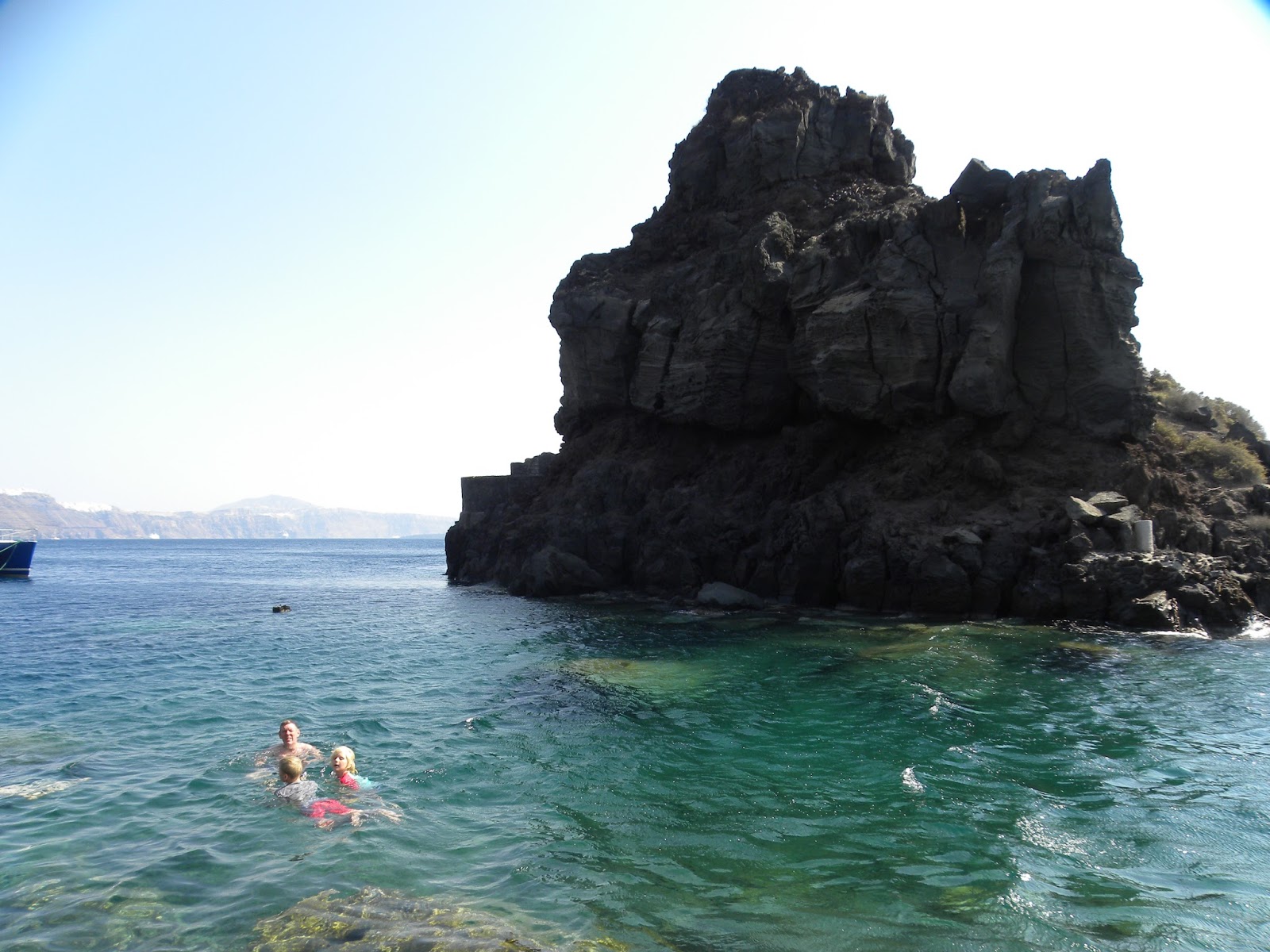
Another beach was called Kamari. A little way out from the shore was a big pile of rocks that you could swim out to.  When Holly and I first got there we found little nooks and crannies filled with sea salt. As we were climbing up to the top of the rocks I saw lots of little fish in the pools. 
The water was very clear because there was no sand to get pushed around by the waves and there were also not very many waves. The water was very salty so it was easy to float.  The beach was also very steep so it got deep very quickly and it was hard to get out. It was also hard because of the pebbles that sunk under your feet.

For lunch and dinner most days we had gyros pitas which is a pita bread with some chicken, chips and some salad and tzatziki. They were really yummy.  One day we tried a pork one but the chicken ones were better.


Another place we went to was called Amoudi Bay. At the top of the island is a village called Oia.  It is very pretty with lots of houses all painted white. There are also some old windmills.


  To get to the bay you have to walk down the cliff. There is a path with a lot of steps. Once you get to the bottom, you have to follow a path until you reach the swimming area in the bay.  The water is very clear and very deep.  You have to jump off the rocks to get in. There was a huge rock sticking out of the water and some people were climbing up it and jumping off it from high up. Swimming there was fun, but afterwards we had to climb the steps again to get back to the village. It was very hot and it was a long way.

There are donkeys at the bottom that you can ride to the top but it is recommended that you don’t ride them because they are not looked after properly and they have to stand all day in the hot sun. When they take the donkeys home for the day they tie each donkey to anther donkey the first donkey has the man riding it to lead the donkeys single file.
In Santorini there are a lot of stray cats that you find eating out of the bins at night. One of the cats was friendly so we fed it some ham the we were given for breakfast. We visited her twice a day.
In Greece they drive on the other side of the road than we do at home and sit on the other side of the car. That’s why dad did not drive.
Most of the people ride motor bikes and quad bikes but they don’t have to wear helmets. Most of the people with quad bikes are the tourists.  
We also went to see the sunset up at Fira that is about 15 or 20-minute walk from where we are staying.

On our last night there was a firework display on the volcano for the volcano festival.They had made it look like it was coming out of the volcano. My favourite part was where they made it look like the lava was flowing out of the volcano.